
Chakra
Advance performance benchmarking and co-design using standardized execution traces.

Purpose
Advancing AI Systems Benchmarking and Co-design using Standardized Execution Traces
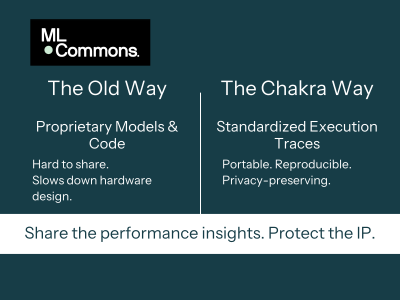
Chakra is an open, interoperable ecosystem for AI systems benchmarking and software-hardware co-design. Developed under MLCommons, Chakra provides a standardized execution trace representation (“Chakra Execution Traces”) that captures the performance-relevant behavior of AI workloads—including compute, communication, memory activity, dependencies, timing, and parallelization—without exposing proprietary models, datasets, or source code. Chakra serves as a common language across AI frameworks, simulators, emulators, replay tools, and production systems, enabling reproducible benchmarking and collaborative co-design across the AI infrastructure stack.
Today, Chakra has grown into a broad industry effort spanning hyperscalers, silicon vendors, networking companies, infrastructure providers, simulation tool developers, startups, and academia. The ecosystem includes native support in PyTorch, NVIDIA NeMo, vLLM, ASTRA-sim, commercial simulation platforms, and multiple internal production environments.
Purpose
Modern AI infrastructure evolves much faster than traditional benchmarking methodologies. Production workloads remain proprietary, simulators use incompatible workload formats, and AI systems are increasingly co-designed across software stacks, accelerators, memory systems, storage, and networking.
Chakra addresses this fragmentation by providing a portable execution trace abstraction that enables users to:
- Collect traces from production AI training and inference workloads
- Replay workload behavior on existing systems for debugging and performance analysis
- Drive simulators and emulators for future software-hardware co-design
- Share realistic workload behavior without exposing proprietary IP
- Build standardized benchmarks and reproducible evaluations across the ecosystem
By separating workload behavior from implementation details, Chakra accelerates benchmarking, optimization, and design-space exploration across the AI infrastructure lifecycle.
Current Working Group Focus
The Chakra Working Group is actively developing:
- Standardized execution trace schemas
- Trace collection from modern AI frameworks (PyTorch, JAX, vLLM, and others)
- Open trace libraries spanning training, post-training, and inference workloads
- Tooling for trace analysis, visualization, replay, and synthesis
- Integration with simulators, emulators, replay frameworks, and hardware validation flows
- Standardized benchmark methodologies built on Chakra traces
- Inference modeling, including emerging workloads such as disaggregated serving, KV-cache movement, and agentic inference
- Storage and memory modeling, enabling faithful representation of modern AI data pipelines and integration with initiatives such as MLPerf Storage and future AI infrastructure benchmarks
Deliverables
- Maintain and evolve the Chakra execution trace standard
- Expand the open Chakra Trace Library with representative AI workloads
- Develop tooling for trace collection, replay, analysis, visualization, and synthesis
- Enable downstream simulators, emulators, replay frameworks, and benchmarking platforms
- Advance standardized benchmarking methodologies built on Chakra traces
- Extend Chakra to emerging AI workloads, including inference, storage, and future AI infrastructure modeling
- Foster an open, vendor-neutral ecosystem for reproducible AI systems benchmarking and co-design
Meeting Schedule
Monday October 19, 2026 – 11:05 – 12:00 Pacific Time
How to Join and Access Chakra Resources
To sign up for the group mailing list, receive the meeting invite, and access shared documents and meeting minutes:
- Fill out our subscription form and indicate that you’d like to join the Chakra Working Group.
- Associate a Google account with your organizational email address.
- Once your request to join the Chakra Working Group is approved, you’ll be able to access the Chakra folder in the Public Google Drive.
To engage in working group discussions, join the group’s channels on the MLCommons Discord server.
To access the GitHub repositories (public):
- If you want to contribute code, please submit your GitHub ID to our subscription form.
- Visit the GitHub repository.
MLSys 2026 Paper
MLCommons Chakra: Advancing Performance Benchmarking and Co-design using Standardized Execution Traces
Read the paper (arXiv)

Brian Coutinho
Co-Chair
Brian Coutinho is a System Software Engineer at NVIDIA, where he builds tools to analyze and optimize the performance of large-scale AI infrastructure. Previously, he was a Performance Engineer at Meta, where he led efforts in AI system observability and made core contributions to open-source systems like the PyTorch Profiler and Dynolog. Brian earned his Master’s degree in Electrical Engineering from the University of Wisconsin–Madison and a B.Tech. degree in Electrical Engineering from the Indian Institute of Technology, Jodhpur.
Winston Liu
Vice-Chair
Winston Liu is Chief Architect for the Network Applications and Security division at Keysight Technologies. Over 25 years in test and measurement, he has led the development of tooling used to validate some of the industry’s most demanding network and data center environments. Most recently, he launched Keysight’s AI Datacenter Builder, a platform for workload-aware validation of AI fabrics, bringing together compute, storage, and network behavior into a single test methodology. His current focus is on how infrastructure-level interactions shape the performance and reliability of distributed AI systems, and on building open, reproducible approaches to evaluate them. He contributes actively to open standards ecosystems including MLCommons Chakra and the Open Traffic Generator initiative.
Tushar Krishna
Co-Chair
Tushar Krishna is an Associate Professor in the School of Electrical & Computer
Engineering at Georgia Institute of Technology. He is also Co-Founder and CEO of
InfraVana. His research spans computer architecture, interconnection networks,
networks-on-chip, and AI/ML accelerator platforms — with a focus on optimizing data
movement in modern computing platforms. He earned his Ph.D. in EECS from MIT
(2014), an M.S.E. from Princeton (2009), and a B.Tech. from IIT Delhi (2007).
Krishna co-founded the MLCommons Chakra working group in 2023. He is also the
creator of the open-source ASTRA-sim (distributed AI system simulation) and SCALE-
sim (AI compute simulation) platforms. He was a recipient of the 2025 ACM SIGDA
Under 40 Innovators Award and the 2026 ACM SIGARCH Maurice Wilkes Award.
Chakra Working Group Chairs
Chairs
To contact all Chakra working group chairs, email [email protected].